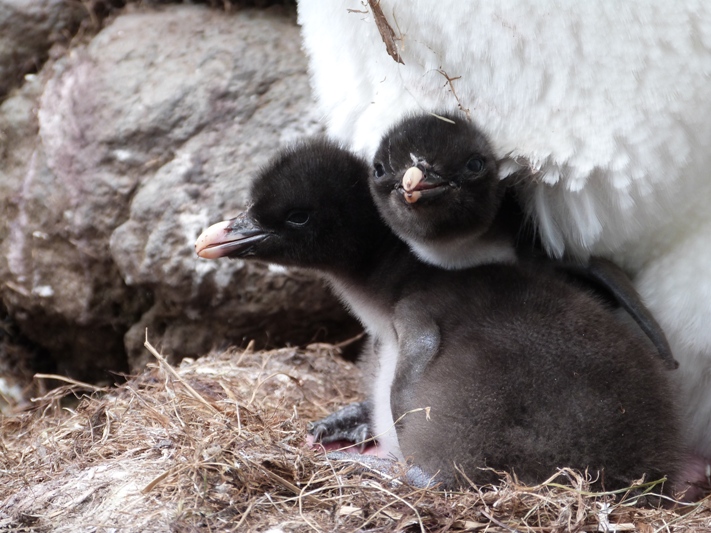
Apart from maybe a few stray penguins in a couple of the photos, this blog is not about Gough's birds. Instead, we're focusing on the spectacular scenery of the island. As the new conservation team is currently being appointed, we thought this blog could be their first orientation about the island, and it will hopefully convey how stunning it really is!
What follows are photographs taken from various points all around the island and a brief description of each place. It is also well worth a look at Chris' blog from the Gough 61 team, for a video showing the Base we call home (http://chrisongough.blogspot.co.za/2016/05/gough-island-base-video-tour.html), as well as a whole load of photos in other posts of all things wonderful and Gough.
The map below has numbers which should hopefully correspond to the photo locations.
 |
| Gough Island with photo locations (Gough archive) |
Photo 1 - Our Jurassic Park welcome sign which greets you off the helicopter up at the helipad.
Photo 2 - Taken from outside the front door of Base, looking towards Gonydale (see later pictures). We get some spectacular sunsets out here and the best starry nights I've ever seen!
Photo 3 - Richmond Hill is the site of one of our Molly census areas and also close to 2 of our Sooty census counts. It isn't the biggest hill but with no path it is horrendous to climb, with burrows everywhere and dense vegetation. Fortunately it is only visited a handful of times throughout the year.
Photos 4, 5 & 6 - Swemgat is about 20 minutes walk from Base. It's a beautiful spot, generally where you fill up water bottles before starting the climb to Gonydale, and the pool at the foot of the waterfall is a perfect place to swim on hot days.
Photo 7 - Admiral's can only be accessed with full rope access gear. It's well worth the abseil for the scenery, and large numbers of penguins and seals. It's one of our Rockhopper census areas, so we visit in October for an incubation count, November for a hatching count and January for a fledgling count.
Photo 8 - About 30-45 minutes from Base, Tumbledown is visited fairly regularly throughout the year. It is another Rockhopper census area, where we weigh Fur Seal pups on a monthly basis and the cliffs are home to some of the monitoring colony of Sooty albatrosses.
Photo 9 - The infamous path to Gonydale. the distance between Gonydale and Base is only a few kms, but the thick vegetation uphill ascent and muddy path make it a fairly tough walk. When you first arrive on the island, before getting used to island walking, it takes about 3 hours; after a few months you'll do it in 2.
Photos 10 & 11 - The amazing Gonydale! Home to the monitoring colony of Tristan Albatrosses of between 150-170 pairs. And also the study colony of Grey Petrels. Gonydale is the main camping spot on the island, and we sleep there on a fairly regular basis. It is also an ideal stop off point before continuing to see the Giant Petrels at Low Hump (see later pictures) or traversing the Rowetts on the way to Waterfall Camp and the North of the island.
Photo 12 & 13 - Tafelkop is separated from Gonydale by a ridge line whose highest point is South Peak at 2493 ft. It is also home to a small colony of Tristans (10-20 pairs) which is monitored with the Gonydale colony. Generally, one member of the team will walk to Gonydale via this route to monitor the few pairs of Gonys before the punishing climb up South Peak and descent to Gonydale.
Photo 14 - Looking towards the North of the island after late winter snowfall. This is a view you get when contouring the Rowetts before descending to Low Hump to monitor the Giant Petrels. Albatross Plain is a Tristan albatross census area which is counted from various points on the Rowett ridge. It can be home to over 300 pairs so is very aptly named! The snowy peak almost in the centre of the picture is Edinburgh Peak which is the highest point of the island at 910m (2986 ft).
Photo 15 - Saddle Island is viewed from the Giant Petrel monitoring colony at Low Hump. Low Hump is home to between 100-200 pairs, and this stretch of coastline is very Jurassic Parky, with the GPs being Gough's very own dinosaurs!
Photo 16 - Whilst climbing up the Rowetts to walk the ridge line, you're rewarded with this view of Hag's Tooth (2270 ft) and the valley leading down to the Glen. The Glen is the site of the old Base on the island and can be reached by a very challenging walk along Disney Ridge (which we plan to do later in the season because The Glen is supposed to be very beautiful).
Photo 17 - Serengeti Plain is another area with stunning views looking across to The Glen, but is a real pain to walk to for standard Gough reasons. Is is another Molly census area and at the bottom of the Plain is Haularound Point which is another Sooty census count.
Photo 18 - Spire Crag is on the West side of the island almost exactly in the middle. It is another busy Tristan Albatross census area home to some 100-200 pairs, and some very interesting rock formations. It is only visited twice a year for the incubation and large chick counts.
Photo 19 - Triple Peak is in the far North of the island and another Tristan census area visited twice a year. The small red arrow is pointing at me to give some perspective of the size of the peak.
Photo 20 - And finally, looking South from the highest point of the island, Edinburgh Peak. Waterfall Camp, the other campsite in the middle of the island, sits at the foot of the mountain. It's just a shame the cloud was quite low on the day I took this photo!
 |
| 1. Welcome to Gough Island (David Kinchin-Smith) |
 |
| 2. Sunset from Base (David Kinchin-Smith) |
 |
| 3. Richmond Hill in mist (David Kinchin-Smith) |
 |
| 4. Swemgat River (David Kinchin-Smith) |
 |
| 5. Swemgat twin waterfall (David Kinchin-Smith) |
 |
| 6. Swemgat (Em Witcutt) |
 |
| 7. Admiral's (David Kinchin-Smith) |
 |
| 8. Tumbledown (Tom Mc Sherry) |
 |
| 9. Gonydale path (David Kinchin-Smith) |
 |
| 10. Gonydale and the Rowetts (David Kinchin-Smith) |
 |
| 11. Sunset at Gonydale (David Kinchin-Smith) |
 |
| 12. Tafelkop Path (David Kinchin-Smith) |
 |
| 13. Tafelkop (David Kinchin-Smith) |
 |
| 14. Albatross Plain & snowy highlands (David Kinchin-Smith) |
 |
| 15. Saddle Island from Low Hump (David Kinchin-Smith) |
 |
| 16. Hag's Tooth descending to The Glen (David Kinchin-Smith) |
 |
| 17. Serengeti Plain & across to The Glen (David Kinchin-Smith) |
 |
| 18. Spire Crag rock formations (David Kinchin-Smith) |
 |
| 19. Triple Peak (Em Witcutt) |
 |
| 20. Top of Edinburgh Peak - 910m (David Kinchin-Smith) |
David