Monday, 31 July 2017

Albatross Expression


When living in such a remote place with so few people, you frequently find yourself talking to the birds. Each one appears to have its own personality, and certainly in Gough's albatrosses the expressions can be all too human. Perhaps these are the ravings of a mad man who has spent too long living out here, but I hope after seeing the photos below you might agree......sort of.


Anger (David Kinchin-Smith)

Indignant (David Kinchin-Smith)

Embarrassment? (David Kinchin-Smith)

Cheery (David Kinchin-Smith)

Nothing's going in! (David Kinchin-Smith)

Confusion (David Kinchin-Smith)

Relaxed (David Kinchin-Smith)

Curiosity (David Kinchin-Smith)

Please leave me alone! (David Kinchin-Smith)

David

Sunday, 16 July 2017

Gonydale's Greys


At this stage of the season we're almost running out of new species to introduce to the blog. But here's another.......the Grey Petrel! Gonydale may well be the home of the Tristan Albatrosses above ground, but beneath their very large, webbed feet are a honeycombed network of burrows belonging to our Grey Petrels (as well as a number of other burrow-nesting species but we'll keep it simple for now).

When we arrived in September 2016 it was to see the final few fledglings emerge from their burrows and fly out to sea, therefore drawing the previous season to a close. The new season didn't really begin until a few months into 2017, and we only discovered our first eggs in mid-March. Eggs started hatching in May and now many burrows across Gonydale have a fluffy chick at the bottom of them.

What makes Gough really special is the fact that we have these winter breeding seabirds as well as those that nest in the summer. Neither Em or I had worked on a seabird colony with seabirds nesting in all 12 months of the year, used to the UK where seabirds are confined to the spring and summer months. By nesting in the winter, Grey Petrels don't have such an abundant food supply compared to the feeding in the summer, but there is less competition from other species. Gough's waters remain rich throughout the year, making it possible for these species to nest at a seemingly inhospitable time. However, perhaps due to this slightly less predictable foraging, the period between hatching and fledging for the chick is highly variable. It could take our fluffy balls just three months from hatching until they emerge from their burrows, or it could take as long as five!

Greys are a very smart, silvery-grey petrel, and when we camp in the mountains we are lulled to sleep by their other-worldy, rattling call. When down at Base, come the evenings, it is possible to watch the Greys flying back in, circling a number of times to gain the height needed to reach their burrows. Because of their fairly protracted breeding season, there will probably be a few fledglings from this year ready to greet the new Gough 63 team come September.

They are great birds, and one of our favourites!


An adult relaxing in Gonydale (David Kinchin-Smith)

Returning home! (David Kinchin-Smith)

Chick feeding time in Gonydale (David Kinchin-Smith)

One of 2016's fledglings (David Kinchin-Smith)

David

Thursday, 6 July 2017

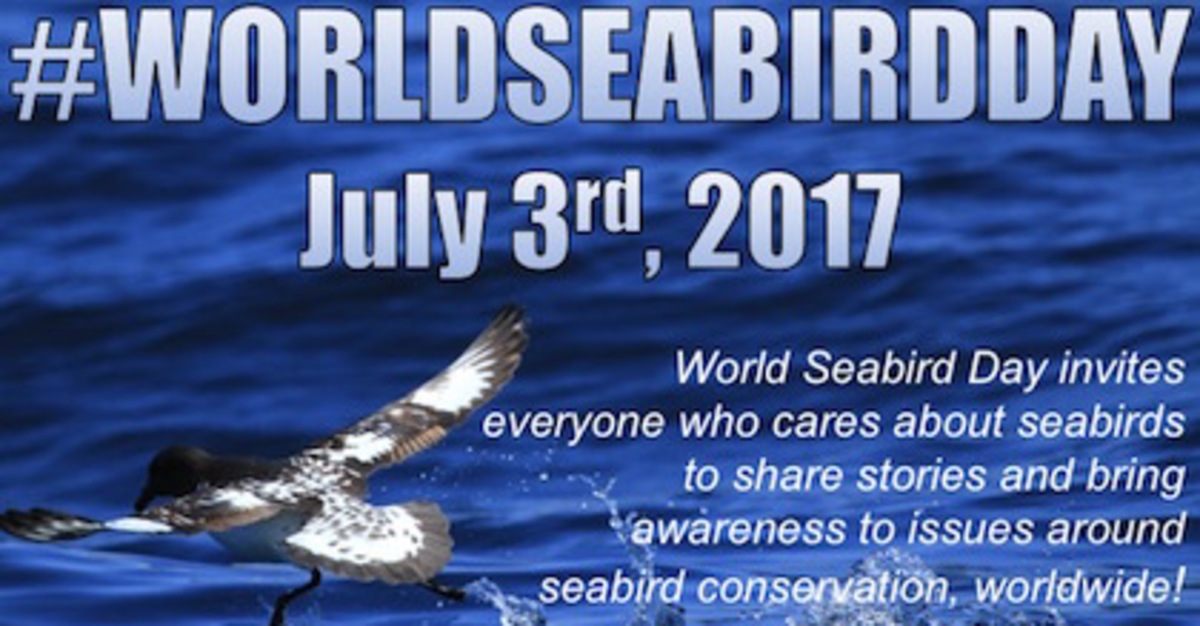
#WorldSeabirdDay


Happy World Seabird Day!!

Happy World Seabird Day

Happy belated World Seabird Day… a day chosen to celebrate these enigmatic creatures and to spread the word of their plight. It’s no coincidence that today is also the 173rd anniversary of the extinction of the Great Auk (think Puffin but MASSIVE!!). I wanted to put this blog up on the 3rd, but our internet out here can be a pain! Better late than never though...

Whenever seabirds are mentioned in the media, frightening statistics follow. Their numbers have dropped by 70% since the 50’s, making them our most threatened group of birds. Half of the 300 species are threatened with extinction, 10% in the near future. Albatrosses and Petrels are particularly at risk. Our own Tristan Albatross for example, now has a breeding population of only around 2,000 pairs, and this figure is dropping each year by 3-5%. That’s maths that simply doesn’t work… if nothing is done they will be gone in the next few decades.


And it’s not just the birds themselves that we need to worry about…. seabirds are what is known in scientific jargon as ‘environmental indicators’. Looking into how they are faring gives us a good idea of how their environment is doing. In this case that means the oceans, and what we are seeing doesn’t bode well.

So why are seabirds in this mess? There are a number of problems, all caused by our own carelessness. One of my recent blogs spoke of the huge amount of plastic in the sea, and the problems this creates, and we have both talked about the devastation being caused by the introduced mice on the island. Predation by introduced mammals is a common theme with seabird declines, and they are also struggling with the ever-present threat of climate change. The industrialisation of the fishing industry in recent decades also has a lot to answer for. Before this, the fishing boats actually helped seabirds, as the discards and offal thrown overboard were an easy source of food. Nowadays though, the vast quantities of fish taken from the sea puts such pressure on the ecosystems found there, and forces seabirds to travel long distances to find enough food. Longline fishing boats are particularly devastating. These vessels trail lines many kilometres long, with baited hooks along their length. As these lines are being let out seabirds dive down to grab the bait before it sinks out of reach, getting hooked themselves in the process. They cannot disentangle themselves, and are simply dragged underwater with the line and drowned.


A Tristan Albatross chick with plastic it vomited (Em Witcutt)

A Northern Gannet tangled in fishing net (David Kinchin-Smith)

Sorry for all the doom and gloom… there is cause for hope! An international ‘Albatross Task Force’ has been set up, and has been spending time on fishing boats, showing fishermen how to prevent seabirds being caught on their hooks. Bird-scaring devices are now a regular feature on fishing boats, and many ingenious and cheap methods have been found to make the hooks safer. On many lines, hooks are encased until they reach a certain depth and are out of reach of the diving birds, when the covering comes away automatically and the hooks are accessible to fish. There are many projects, including here on Gough, to remove introduced predators from important seabird islands, some of which have been successful already. Nature reserves have been protecting seabird colonies for many years, and the much newer concept of protected areas at sea are helping to safeguard their feeding areas. With luck, we can turn the tide for these beautiful birds before it is too late!


Em 

Friday, 30 June 2017

Midwinter in the South Atlantic!

Happy belated midwinter from Gough Island! 

Midwinter is one of the best island traditions. It is the most important celebration on all of the southern Bases. It was actually last Wednesday, but one of our team members was observing Ramadan so we postponed our celebrations until he could join in too. In fact, the two of us spent the actual mid-winter up at Gonydale with the Tristan Albatrosses. The youngsters are doing well, we have more than usual for this time of year and they’re getting huge! The largest is almost 8 kg and getting bigger by the day.

Our midwinter dawned with cold temperatures, gale force winds and heavy rain; not ideal given the island tradition of a team swim in a beautiful cove called Swimgat near the Base. Still, the bravest (or perhaps just stupidest) of us set off for a very cold, and very brief dip in the freezing waters running off the mountains.

A chilly dip at Swimgat (Tom McSherry)

Much of the afternoon was spent preparing our midwinter feast and decorating the dining room with a beautifully set table, paper chains, and even a snowstorm. With everyone dressed for dinner, we sat down to enjoy roast lamb or chicken, with chocolate cake and apple pie for pudding.

The table set and ready (Em Witcutt)

Midwinter snow, even on Gough! (Em Witcutt)

Our midwinter feast (Tom McSherry)


We finished up with drinks, games, and dancing in the bar. The whole day was a lot of fun, and a welcome break from what can be a monotonous life on Base.

The boys playing pool (Tom McSherry)

Fun in the bar (Tom McSherry)


Dancing the night away (Tom McSherry)

On Gough, midwinter also marks the start of the home stretch of each expedition. Come September the SA Agulhas will arrive with the new team, and will take us back to South Africa. From there, we’ll head home to the UK. The island is an incredible place and we both love our work here, but we left home almost a year ago, so are both looking forward to seeing our families again. That, and fresh milk and vegetables!

Sunday, 25 June 2017

Time To Say Goodbye


Apologies for the lack of blog posts recently, internet has been down in the South Atlantic for the last two and a half weeks; it’s amazing that we have internet out here at all!

Anyway, this post was supposed to be from a few weeks ago, so here it is now…..

Mid-winter’s day has just passed and the island has most definitely entered the quieter winter period. All Mollys have departed and more recently we said goodbye to our final Sooty fledgling. Our first Molly egg was laid in the study colony on 22nd September 2016 and the final fledgling departed on 24th April 2017. Our first Sooty egg was laid in the study colony on 30th September 2016 and the final fledgling left the island on 8th June 2017.

Neither of us have had the pleasure to monitor a species for such a long time before. It has been fascinating to watch these chicks grow over the months, and we have watched our albatross friends leave Gough with fairly mixed emotions.

Below are some final photos of this season’s birds, including the moment when one of our young Mollys took its first ever flight, after months of patiently waiting on the ground.


A final wing test (David Kinchin-Smith)

Lift off! (David Kinchin-Smith)

What a feeling! (David Kinchin-Smith)

And out into the Atlantic (David Kinchin-Smith)

Practice makes perfect (David Kinchin-Smith)

One final Sooty (David Kinchin-Smith

An adult....but you get the idea (David Kinchin-Smith)


David

Saturday, 3 June 2017

Plastic Peril

Last week we headed up to the Tristan Albatross colony at Gonydale to monitor this year’s breeding attempt. So far so good, we still have over 120 chicks. The mice are keeping their distance, and we’ve only had a few failed nests. Fingers crossed that many of these chicks will make it to fledging age.

It isn’t just the mice that threaten these beautiful birds though. Whilst visiting the colony, we came across a stark reminder that even those chicks that grow to fledging age still face some daunting statistics. Chief amongst the threats they face out to sea are long-line fishing vessels, which often catch albatrosses accidentally, and the vast amount of waste plastic that makes its way into our oceans. There has been a lot in the news recently about the millions of plastic bags, bottles and other items from our throwaway society. Albatrosses hunt for food on or near the surface of the water, where a lot of this debris ends up, and a floating plastic bag can look remarkably similar to a squid. Albatrosses will dive down and swallow it whole, where it then sits in the bird’s stomach and doesn’t break down or biodegrade. Scientists carrying out dissections often come across birds which stomachs so full of plastic that there is literally no space for anything else.

Better out than in... (Em Witcutt)

One of our young chicks vomited a plastic bag while we were visiting the colony. These are birds that are too young to fly, and so have never left the mountains of Gough. One of its parents must have swallowed a plastic bag and unwittingly brought it back to feed to its chick. It’s shocking to think that even here, in a place so untouched by humans, wildlife is still threatened by us.

Still, it’s not all doom and gloom. The Albatross Task Force is constantly working to help fisheries change the way they fish to reduce the threat to albatrosses, and there are many initiatives around the world to clean up the oceans. People are becoming ever more aware of how our actions impact the world around us, so hopefully our lovely albatrosses will face far fewer threats in the future.


Em

Sunday, 21 May 2017

A GREAT Send-off


They have been with us since we arrived on Gough in September 2016, but soon the island will be empty of Great Shearwaters. For the last couple of weeks, the chicks of Gough 62 have been leaving the safety of their burrows for the last time and flying out into the Atlantic. Considering we only found our first hatched chicks at the very beginning of January, it's been a bit of a marathon for our wonderful adults to raise their youngsters.


February (David Kinchin-Smith)

April (Em Witcutt)

The Base on Gough is surrounded by Great Shearwater burrows. It has been fantastic to walk along the boardwalks at night throughout the season and have adults landing (sometimes not particularly gracefully) all around you, listening to their wailing cries. With very few adults now feeding the remaining chicks, the nights are quieter but we are lucky enough to see the fledglings emerge from their burrows each night and make their way to the cliff edges and out to sea.


And now.....(David Kinchin-Smith)

Adult (Top), Fledgling (Bottom) (DKS)

The spectacle of 2 million Great Shearwaters returning to Gough to pair up and clean burrows will be one of the first sights which greet the Gough 63 team come September. And still, after many months on the island, it is perhaps the sight I feel most privileged to have witnessed.....what a bird!


Just how many!? (David Kinchin-Smith)

David